
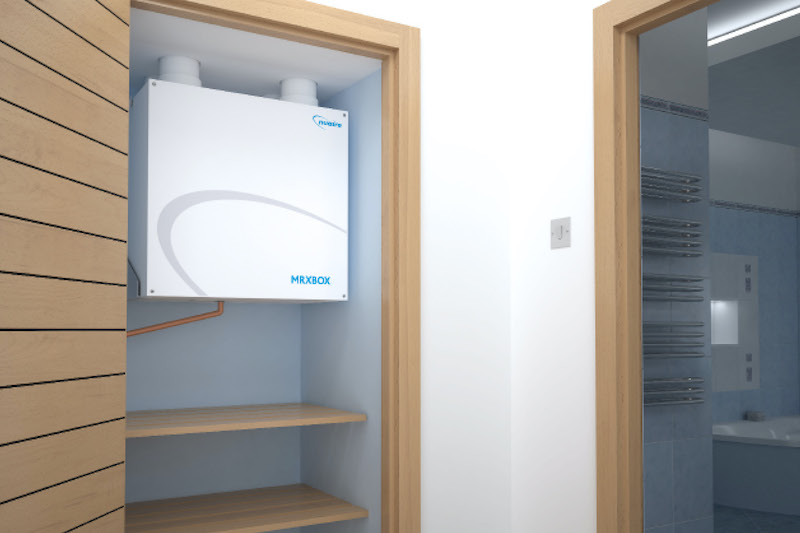
Effective ventilation is the key to more energy efficient, sustainable and healthy buildings, says Mike Brown from Nuaire.
Our daily news feeds are full of alarming stories of environmental concerns and what we can do to create better efficiencies and make our buildings kinder to the planet. This, coupled with the astronomical rise of fuel prices and cost of living, has got many thinking about what can be done to make our buildings more energy efficient and environmentally friendly.
Developers are looking to more sustainable and cost-effective means, such as better insulation, air or ground source heat pumps, solar panels and double – if not triple – glazing to futureproof buildings.
Airtight buildings
With modern methods of construction and developments in insulation and glazing, buildings are becoming more airtight – meaning that natural ventilation and air leakage is restricted. This is a good thing for energy efficiency, but there comes a greater need to ventilate effectively, and often mechanical means need to be employed.
Without effective ventilation in an air-tight building, pollutants can become trapped as there is nowhere for them to escape. The lack of natural fresh air movement through the space results in a build-up of carbon dioxide, VOCs and particulate matter as well as condensation, damp and mould, which can be harmful to not only the building but those occupying it.
Indoor air quality isn’t the only concern. Outdoor air should also be a factor of consideration. The quality of the air outside can alter dramatically depending on environmental factors surrounding the building itself, having a further impact on the air quality inside. For example, built up areas will be at risk of higher levels of carbon and emissions of nitrogen oxides (NOx), which enter the building and cause harm to human health if not dealt with.
Providing adequate air filtration for the supply air into a building is as important as ventilating the air inside to keep a building healthy.
The solution
Typically, buildings are fitted with general extractor fans, which have a core purpose of removing moisture-laden and polluted air in most cases. But this will include the warm air from within the building, dumping it outside into the atmosphere, which isn’t good for the planet or the occupants inside – so as the air is heated, it’s almost instantly removed again.
The best way to create healthier and more sustainable and energy efficient buildings and homes is to replace these extractor fans with a superior mechanical ventilation unit with heat recovery (MVHR).
MVHR systems work by combining supply and extract in one unit. Moisture-laden, stale air is extracted, while the system will quietly and efficiently provide the building with fresh, filtered air all year round, improving the indoor air quality and reducing dust and allergen levels throughout.
Most systems are compact and lightweight, and also easy to install, including fan controls designed for quick and easy commissioning. Units are low maintenance and provide easy access to filters for cleaning.
MVHR heat recovery systems essentially provide optimised, balanced ventilation with heat recovery at 95%. So, unlike a simple air vent that allows heat to freely flow out into the atmosphere, these systems pass the extracted air over a heat exchange cell which recovers and retains the heat that would otherwise be lost. As a result, occupants see a cleaner, tempered air supply coming into the building.
Not only does this improve the indoor air quality, by filtering the incoming air – it helps to keep the building warm – thus reducing the energy input it takes to heat it. Then, in the warmer months when cooling is required to maintain comfort levels, MVHR units offer a 100% bypass with no loss of resistance.
Intelligent control
For added efficiencies, these solutions work best with a fully on-demand ventilation system control base.
Currently, only one in five commercial buildings operate with a basic Building Management System (BMS)and only 80% are operating at class ‘C’ energy efficiency with timer-based programming (rather than sensor-based, demand orientated activation when it comes to ventilation).
But advanced functionality and expanded solutions when it comes to smart controls can provide impactful energy efficiency and cost savings with networked connectivity and site-specific controls that monitor trends to adapt to meet site requirements.
With the adoption of smart controls for these operations, buildings would see better indoor air quality and greater efficiencies in each season, from summer through to winter.
A greater focus needs to be placed on indoor air quality – something which currently appears to be a no man’s land within Building Regulations, with complete lack of emphasis on ventilation effectiveness. Although the government is trying to shine a spotlight on air quality, it’s not enough and these important considerations within any building, be it for schools, offices or at home, will be essential for the ongoing protection of the occupants who will be making use of that space.
Made to measure
At Nuaire, we focus on the design of low-energy heat recovery systems and have been developing and manufacturing market-leading solutions for years. We offer a wide range of MVHR systems to suit every size and type of building – from residential properties, such as small apartments and homes with multiple wet rooms, to applications for hotels, shopping centres, schools and offices.
We work closely with our clients to develop specific solutions for their requirements and share best practice advice.
Going forward I’d like to see a switch in new building installations, and ventilation retrofit, to consider heat recovery units over general extract fans to future proof our buildings and make them more environmentally friendly, heat efficient and provide clean filtered air into occupied spaces – in turn, saving money on fuel costs and keeping indoor air quality healthy for years to come.
