
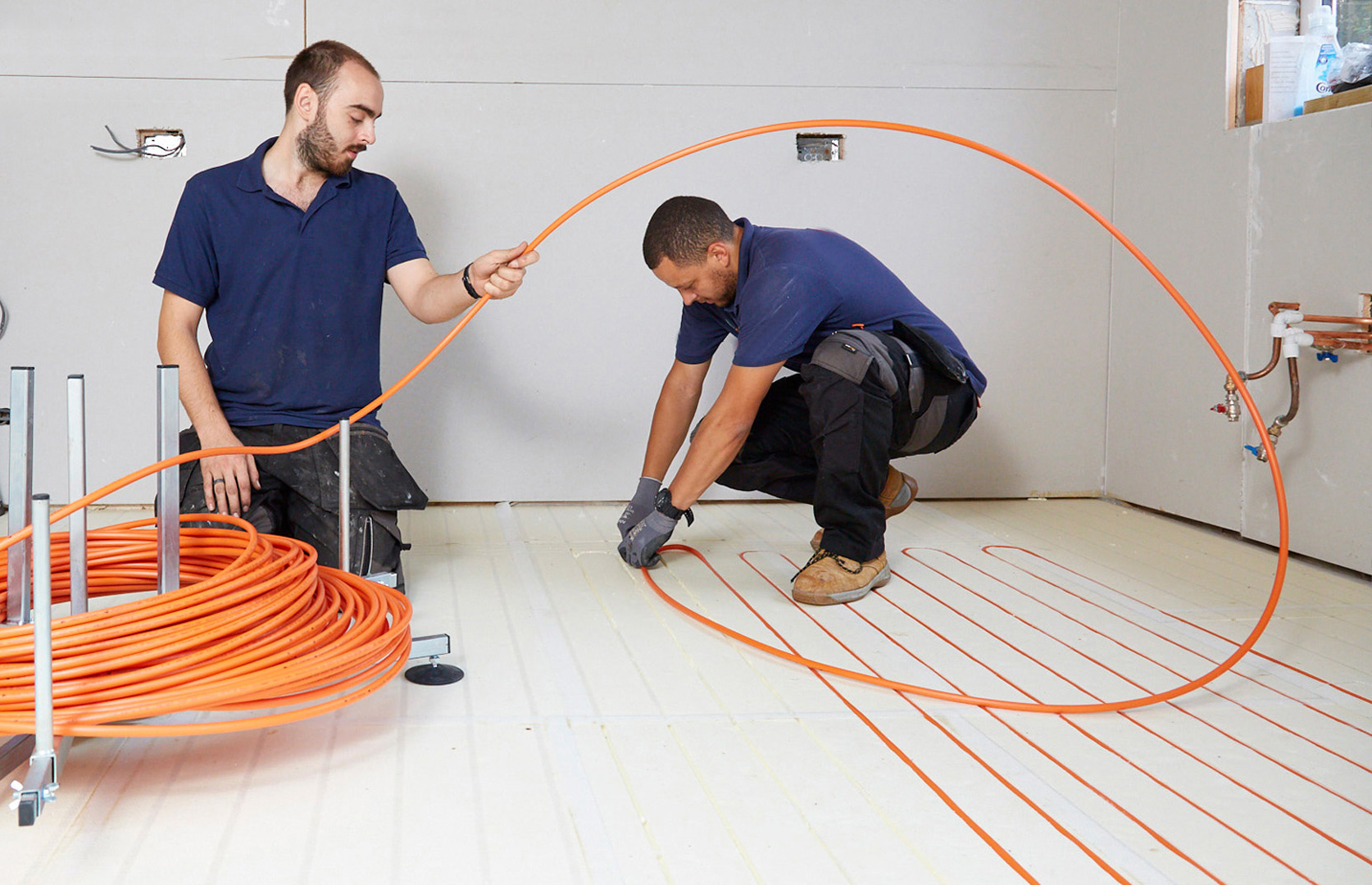
Underfloor heating can help homeowners get the most out of their heat pumps and low-temperature heating systems, as Chris Ingram, Chairman of the BEAMA Underfloor Heating Group marketing sub-committee, explains.
Low-temperature heating systems are undeniably becoming the focus of the government’s plans for the UK heating industry, and the way increasing numbers of homeowners will heat their homes in the coming years. While the complete ban on gas boilers in newbuild properties may have been pushed back from its original 2025 implementation date, the government has recently confirmed the introduction of the Clean Heat Market Mechanism (CHMM) which will place an obligation on boiler manufacturers to meet mandatory targets on the number of heat pumps they sell each year relative to the number of boilers they sell, with financial penalties if they fail to meet these targets.
The introduction of the CHMM is clearly designed to force an increase in the number of heat pumps being installed in the UK each year. This increase in badly needed, considering the Government’s goal to reach 600,000 installations per year by 2028 – and the fact that only around 18,000 were installed in the first half of 2023.
The CHMM is the latest step in the Government’s plans to transition the heating industry over to low-temperature heating systems, following recent changes to Building Regulation Part L that mandate a maximum flow temperature of just 50°C in all new heating system installations.
Low temperature systems
So, where does underfloor heating (UFH) fit in with these new systems? Well, the Government is pushing for low-temperature heat pump systems instead of boiler-led systems because of the improved efficiency levels they offer, which will help the UK’s attempts to meet its legally binding net zero obligations.
Heat pumps operate on much lower temperatures than gas or oil boilers, reducing energy losses throughout the system and maximising the heat output gained from every kW of energy being consumed. But to truly make the most of the efficiencies offered by heat pumps and other low-temperature heating systems, installers must consider the entire system, by pairing the heat pump with a low-temperature heat emitter such as UFH.
UFH is a proven heating technology that has been in use as a low-temperature heating system for decades. And it’s a system that homeowners understand and are comfortable with having fitted in their homes, having embraced the luxurious comfort, warmth and efficiency that it offers.
While it’s true that low-temperature heating systems can be fitted with radiators and other heat emitters, the installer would need to fit larger than normal radiators, or more radiators, throughout the home to generate sufficient heat outputs. Because UFH transforms the entire floor of a building into a giant heat emitter, this gives the system a much larger surface area to emit heat from, and so the system itself can run at a lower overall flow temperature without compromising the heat output for the occupants.
UFH systems emit 60:40 radiant heat, compared to radiators which tend to emit 70:30 convected heat, which rises rapidly to the ceiling, making the occupants feel colder, because the heat gathers above their heads.
Since UFH emits heat evenly across the whole floor surface, optimum comfort can be achieved everywhere in the room. In fact, room thermostats can be set 1-2°C lower with UFH heating than with a radiator system and the room will still feel comfortable, helping homeowners make additional significant savings on fuel costs.
Independent research
UFH’s status as an extremely efficient heat emitter have further been supported by a number of tests and studied carried out both in the UK and Denmark.
Independent research commissioned by EURAY (the European UFH trade association) in 2005 proved that UFH was significantly more efficient than radiators with any heat source and in any type of building. This study, undertaken by Prof Bjarne W. Olesen of the International Centre for Indoor Environment and Energy in Denmark, was a landmark comparison of emitter efficiencies and directly led to the inclusion of UFH in the Green Deal technology list as the only efficient emitter. Further studies carried out by Prof Olesen in 2008, which focused on UK conditions specifically, also supported his previous findings that UFH was the most efficient type of emitter.
Prof Olesen’s second study found that, compared to a low-temperature boiler/radiator system, a boiler/UFH system uses between 5% and 15% less energy. When coupled with a heat pump the savings are significantly more, with CO2 savings following a similar trend.
The study also demonstrated that, with a flow temperature of 55°C, radiators would need to be double their current size to enable a sufficient room temperature. And, while UFH could still easily heat the space with a flow temperature of 35°C, radiators would need to be almost seven times the size to heat the room to the required comfort level. Even a doubling of radiator sizes clearly raises questions of both practicality, such as use of precious living space, and of the embedded carbon involved in the manufacture and distribution of radiators.
UFH can be used in both newbuild and retrofit projects and with surface temperatures of around 27°C can be more responsive and controllable, offers a design life twice as long as other emitters, and at even lower flow temperatures (e.g., 35°C) can offer even greater efficiency.
BEAMA Underfloor Heating Group is the UK’s national trade association for UFH. To learn more and find out how to become a member, please visit: beama.org.uk
