
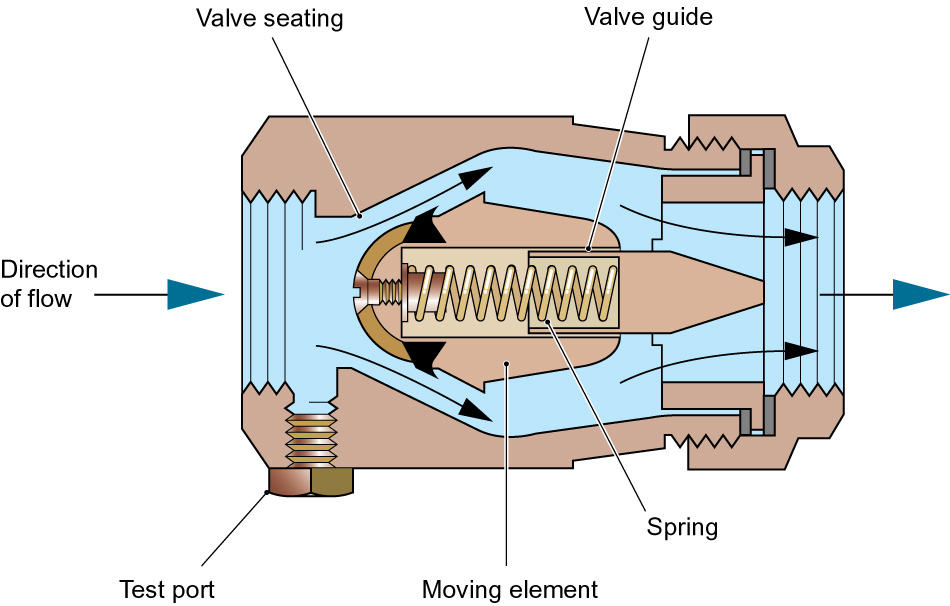
Many manufacturers, suppliers and installers use ‘non-return valve’ and ‘check valve’ to mean the same device, unaware that they are different and that there are legal requirements to only use check valves for backflow prevention. Steve Tuckwell from WRAS explains more.
What’s the simplest way to stop backflow in a pipe or fitting? Many installers would suggest the use of a non-return valve, others might advise using a check valve. Aren’t check valves and non-return valves the same thing?
Fundamentally, check valves (CVs) and non-return valves (NRVs) are different fittings and serve different purposes. Under UK plumbing regulations, the ‘check valve’ has a specific purpose as a device legally permitted to be used to prevent backflow in defined circumstances. The non-return valve, whilst useful for preventing reverse flow in pipes in many situations, is not a recognised backflow prevention device. There are different performance specifications for each type of device and non-return valves have to meet less demanding standards than check valves.
For non-return valves the simplest design is the swing valve with a weighted flap which is held open by forward flowing water. If flow reverses it closes under its weight and is kept shut by back pressure acting on the closed flap. The wafer flap valve is a slimmer version of the same design. Other designs include the tilted plate NRV and the ball NRV.
By definition, check valves have a moving element (the obturator) which is held open by the forward flow. If the forward flow ceases, the moving element is held on the valve seat by spring action assisted by back pressure, sealing off backflow.
Rules & Regs
In the UK the Water Supply (Water Fittings) Regulations and Water Supply (Water Fittings) (Scotland) Byelaws 2014 (the Regulations) require that every water system contains an adequate device for preventing backflow of fluid from any appliance, fitting or process (Schedule 2:15). Most importantly, to be ‘adequate’ the device must be of a type approved by the Secretary of State for the Environment in the ‘Regulator’s Specification for backflow prevention arrangements and devices’.
This Specification states the maximum degree of backflow protection (the fluid category) which each type of device legally provides. The Regulator has approved the use of check valves up to fluid category three, but crucially, non-return valves are not included in the types of fittings approved for backflow prevention purposes.
Similarly, non-return valves are not recognised in the British Standard BSEN 1717 (2001) (‘Protection against pollution of potable water in water installations and general requirements of devices to prevent pollution by backflow’), which describes backflow prevention devices that are accepted in the EU.
So, if the regulations require fluid category two backflow prevention in a plumbing system, a single check valve will meet that requirement, but a non-return valve will not be legal.
Industry confusion
There’s industry-wide confusion surrounding the naming of NRVs and CVs, with manufacturers’ and suppliers’ websites using either name, or sometimes both, for the same type of device. This has led to problems where alterations have been done to comply with an enforcement notice issued by the water supplier requiring additional check valves. In several cases installers have unknowingly purchased NRVs, only to have to replace them with the correct check valves when the water supplier re-inspects the work.
The regulations require fittings ‘to be of an appropriate quality and standard’, and fittings with WRAS Approval demonstrate this by meeting the standards set out in the Government’s Performance Specification.
There are important differences in the designated performance standards required of NRVs and CVs. For example, check valves undergo an endurance test which requires they are still leak-tight after being operated in backflow mode up to 80,000 times using hot water.
CVs are also tested to check that the valve does not stick if the valve body is put under a bending stress and that high flow velocities do not dislodge or damage internal components. In the water-tightness tests, NRVs are permitted a 10% loss over 24 hours, whereas for CVs it is 0%. As backflow prevention devices, CVs require testing for dezincification resistance, which is not required for NRVs.
So whilst there’s nothing at all wrong with non-return valves, which serve a useful purpose in preventing reverse flow in pipes, they are the wrong fittings where there is a legal requirement for a recognised backflow prevention device. Manufacturers, suppliers and installers need to be clear about which type of valve they are making, selling or using and we should all try harder to use the accurate name to describe them.
Find out more
Further information is available from WRAS via email (info@wras.co.uk) or by calling the technical enquiry service on 0333 207 9030. Details of WRAS Approved check valves and non-return valves is available free in the Water Fittings and Materials Directory on the WRAS website (www.wras.co.uk).
